Mobius Project is a research-and-build initiative for reflective, question-evolving AI systems. As of 2026, the project has moved from theory to running code: the MOBIUS open-source stack is public on GitHub, alongside a research corpus of 56 public records on Zenodo and a twelve-title book library on Kindle.
On this page: Books · Open Source · Research & Publications · Commercial Licensing · News
Naming: Möbius — the concept and the books · Mobius — the project · MOBIUS — the company (MOBIUS LLC).
Reflect Möbius Phenomenon: Metacognitive Questioning, Dimensional Leaps, and AI Evolutionary Systems
This book systematically presents the foundational theory of the Möbius Phenomenon. It proposes a new paradigm in which AI evolves through metacognitive questioning and dimensional leaps, and provides both theoretical foundations and practical approaches for implementing self-reflection, question-driven evolution, and continuous learning in AI systems. A revised 2026 edition anchors the twelve-title Möbius Library on Kindle (below).

Möbius AI Project
Möbius Project:
A research-and-build initiative developing a reflective AI framework toward a modular core for question-evolving AI.
The project focuses on how advanced AI systems can revise their inquiry space while remaining reviewable by design—with traceability, corrigibility, and boundary/interface discipline treated as first-class constraints. This is positioned as an alignment-relevant posture for real deployment contexts, where human–AI co-evolution and governance requirements cannot be ignored.
The theoretical program is now backed by released implementations: the MOBIUS stack (below) is published as open source (AGPL-3.0), with architecture, doctrine, and evaluation methodology documented in the RC3.3 release set on Zenodo.
Initiated in 2024. First public open-source releases shipped in 2026.
AI Answers. But Whose Question Is It?: The Möbius Project and the Future of Thinking
The program's second flagship book. When AI can answer everything, the scarce resource is no longer the answer — it is the question, and the right to ask it. This book carries the answer-entitlement argument from research into everyday language: how question ownership, hesitation, and governed answering reshape thinking, work, and public memory. Revised 2026 edition; also available in Japanese.
Flagship Paper — The Unasked Question (2026.6)
The Unasked Question: Answer Entitlement and the Act-Disvalue of Unwarranted Response. The normative core of the Möbius program: before asking whether an answer is correct, ask whether answering is justified at all. This is the thesis the MMV runtime implements in code, the flagship books carry into everyday language, and the 2026 measurement campaign tests empirically.
Zenodo.org — https://zenodo.org/records/20606883
Flagship Paper (Verification) — Termination by Novelty (2026.8)
Termination by Novelty: A Machine-Checked Theory of Anti-Regress Guards for Reflective Governance Processes. The Unasked Question states what the program claims; this states how a claim is shown to hold. For a self-revising process under a novelty guard — every accepted transition must be semantically non-zero, and no-change must be declared explicitly — the theorems say the process cannot loop forever while appearing to progress: silent stagnation becomes a terminating, detectable state. Proposition 1 and both termination theorems are machine-checked in Lean 4 (core, no external libraries; the tightness of the Theorem 1 bound is an elementary hand proof). The checked artifact ships with the paper, so the proof can be re-run rather than taken on trust.
Zenodo.org — https://zenodo.org/records/21837211
Books — The Möbius Library on Kindle (2026)
In July 2026 the project's book program was re-issued on Amazon Kindle as an eleven-title library of revised 2026 editions — theory and method, AI & society (English and Japanese editions), and fiction. In August 2026 the library grew to twelve titles with The AI Ratchet, a practical method book on compounding human–AI dialogue (English edition).
Theory & Method
AI & Society
Open Source — The MOBIUS Stack (2026)
The public prototype is out. Between June and September 2026 the project released eighteen repositories under AGPL-3.0 at github.com/mobius-style. Together they form one governed stack: decide whether answering is justified, govern what the model may read, verify what it claims to remember — and leave a reviewable trace at every step.
mmv — Answer Entitlement runtime
Local-first conversational AI runtime that decides whether answering is justified before responding — retrieval and evidence verification over a multilingual FAISS/ME5 Wikipedia index. Runs fully local (Ollama) or in the cloud.
github.com/mobius-style/mmv
infinity — governed API
MOBIUS INFINITY combines governed answer-entitlement (MMV) with reflective questioning (RQA) behind an OpenAI-compatible API. Patent pending.
github.com/mobius-style/infinity
rqa — memory-echo governance
For LLM assistants with memory: provenance-tagged memory plus deterministic output-time self-citation verification, with an empirical pilot.
github.com/mobius-style/rqa
rcgov — context governor
Mobius Reflective Context Governor — local-first semantic hygiene and context governance: govern what a model is allowed to read before it answers.
github.com/mobius-style/rcgov
mmv-secretary — self-evolving secretary
A grow-your-own secretary addon: permission-laddered verb CLI plus a reversibility charter — immutable kernel, generation ledger, RGS/RHL anti-regress, auto-rollback. Ships as a seed: you sign the charter and it grows from generation 0.
github.com/mobius-style/mmv-secretary
mmv-voice — governed voice pipeline
Whisper transcription with MMV-governed formatting: chunk-level fidelity verification, speaker attribution, minutes and digest output. Local models by default, opt-in cloud.
github.com/mobius-style/mmv-voice
memgov — memory governance
Cross-agent memory governance: treat persistent agent memory as governed context, not live state — the Reflective Context Governor transplanted onto agent memory.
github.com/mobius-style/memgov
rsg-cfsi — governed indicator reference
Reference implementation of RSG-CFSI, a regularized financial stress indicator with out-of-sample stability — the stack's audit-envelope discipline applied outside AI.
github.com/mobius-style/rsg-cfsi
mobius-governance — governance layer
Answer only when warranted; inject only what is fit to govern. MMV answer-entitlement + RCGov context governance as a model-independent layer and OpenAI-compatible proxy you put in front of any model — negligible added latency, no reflective-questioning overhead.
github.com/mobius-style/mobius-governance
gemma-4-12b-mobius-custom — governed model
Google Gemma 4 12B (4-bit) with the governance layer baked in as trust_remote_code: it refuses or defers instead of guessing and cleans retrieved context before reading it. Runs in ~8 GB VRAM.
huggingface.co/moebiusT7/gemma-4-12b-mobius-custom
Applied showcase — tokyo-insight: a citation-grounded civic-RAG engine for Tokyo Metropolitan Assembly deliberation records (plenary and all committees, 1999–present). A working demonstration of the stack's evidence discipline on real civic data. github.com/mobius-style/tokyo-insight — systems paper: Public, but Unread (2026.7)
New in August 2026 — mobius-browser-guard, an auditable mediation layer for Claude in Chrome; reflective-budget-governor, pre-registered early stopping for iterative refinement; and five study-artifact repositories backing the August papers: machine-habitus, machine-doxa, guardrail-silent-degradation, gemma4-quant-regime-study, gemma4-mtp-quality-study.
New in September 2026 — answer-entitlement-prereg, a third-party preregistration package and executable validator for a confirmatory test of multi-route answer-entitlement gating (1,560 bilingual paired cases, frozen scorer). No study has been run and no efficacy is claimed: the validator refuses to report a runnable study while any external authorization is missing.
Commercial licensing — The MOBIUS stack is AGPL-3.0-or-later. If your organization cannot meet AGPL's source-disclosure obligations, a commercial license is available from MOBIUS LLC, the sole rights holder: USD 500 per month per company, cancel anytime, no minimum term (annual invoicing at USD 5,000/year). It is a license grant, not a service: no service is performed, no data of yours is accessed, and nothing you run depends on our availability. Contact: info@mobius.style
Research & Publications (2026)
The 2026 release wave is documented in a series of papers and reference artifacts on Zenodo — 56 public records as of September 2026, including a companion systems paper for every released repository and a six-paper formal theory series. Selected highlights below.
New — Executable Preregistration & Act-Level Governance (2026.8)
Two papers from late August 2026: one registers a study whose protocol its own instrument enforces, the other states the act-locus argument the governance stack is built on.
- Preregistration as an Executable Contract — a machine-enforced protocol for a paired N=800 evaluation of an LLM-agent assurance plane. The run is authorized once under a reserved nonce and the analysis path is fixed in advance, so several classes of protocol deviation are refused by the instrument rather than discouraged by the document. At publication the study is registered but not executed — what is verified is the instrument, not a result.
zenodo.org/records/22138712 - Empty Text, Normed Acts — why pattern enumeration loses to attack variation, and why the mediation point that survives is not the text but the typed act at the boundary, checked against an explicit authorization norm.
zenodo.org/records/22139691
Measurement & Governance Studies (2026.8)
Four empirical papers from August 2026 — pre-registered or adversarially reviewed, each shipping with a public study-artifact repository on GitHub.
- Measuring Machine Habitus & Machine Doxa — a pre-registered pair: the dispositional structure of a model population, and the consensus layer where all models agree.
zenodo.org/records/21982393 · zenodo.org/records/21982857 - The Reflective Budget Governor — equilibrium-based early stopping for iterative refinement; reduces reflection budgets by 33–37% in the paper's evaluation, with a reference implementation.
zenodo.org/records/22031367 - A Guardrail That Failed Quietly — a production injection defense that degraded silently, found and corrected through the project's own governance loop.
zenodo.org/records/21903321 - Quantization Regime and Governed Routing — a 2×2 study of QAT Q4_0 versus PTQ Q4_K_M under a fixed governance stack.
zenodo.org/records/21903706
The Theory Series (2026.8)
Six formal papers supplying the theorem layer beneath the MOBIUS architecture. Every claim is graded, every paper states its break conditions, and the T1 core is machine-checked in Lean 4.
- T1 — Termination by Novelty: anti-regress guards, with a machine-checked core — zenodo.org/records/21837211
- T2 — Sequential, Never Layered: why governance overlays must not stack — zenodo.org/records/21837213
- T3 — Why Reflection Should Be Shallow: finite optimal depth and the rumination regime — zenodo.org/records/21837215
- T4 — The Crossover Theorem: capacity crossovers and axis-blind gate impossibility — zenodo.org/records/21837217
- T5 — The Exact Perimeter of Semantic Energy: what I(Y;Z) does and does not license — zenodo.org/records/21837223
- T6 — What Two Gates Buy You: abstention cascades and log non-identifiability — zenodo.org/records/21837226
The Unasked Question (2026.6)
Answer entitlement and the act-disvalue of unwarranted response — the normative core behind MMV.
zenodo.org/records/20606883
Operation Entitlement (2026.6)
External governance and the making of a 12B clerk — an empirical account of governed small-model operation.
zenodo.org/records/20607475
Role-Semantic Convergence (2026.6)
Role-semantic convergence under reflective document exposure — a controlled cross-sectional study.
zenodo.org/records/20523511
MMV System Overview RC v3.3 (2026.5)
The released runtime, documented: architecture, gates, and release discipline — with the companion Mathematical Modeling Doctrine.
zenodo.org/records/20422968
AI Co-Observation Protocol 2.0 (2026.5)
AICP-2.0 — reflective equilibrium applied to human–AI co-creation.
zenodo.org/records/20422259
OPERATE-R Freshness Routing v0.3.6 (2026.6)
Route-first evaluation for temporal volatility — the benchmark track behind MMV's routing layer.
zenodo.org/records/20510114
The Ledger and the Gate (2026.7)
A reverse-derived Möbius cosmology — five theses recovered bottom-up from validated engineering, closing the loop between running code and doctrine.
zenodo.org/records/21222362
Governance Dose Must Match Model Capacity (2026.7)
A dose–response study of inference-time governance interventions across model capacity — the empirical core of the July measurement campaign.
zenodo.org/records/21222310
Governance, Not Servitude (2026.7)
Reversibility-based institutional design for working human–AI relations — from role definition to an executable charter.
zenodo.org/records/21230927
Governance Before Generation (2026.7)
An N=100 A/B on one Gemma 4 12B: with the governance layer in front, prompt-injection compliance and credential leakage fall from 57% to 0%, at ~1.3 ms added latency — measured, not asserted.
zenodo.org/records/21357562
The measured artifact, runnable
The paper's numbers are reproducible on the released artifacts: the governed model on Hugging Face and the model-independent layer on GitHub, both with the benchmark included.
Hugging Face model · GitHub layer

About me
Mobius AI Project Founder:
Taiko Toeda
Independent researcher working on reflective AI architecture and AI governance.
I lead the Möbius Project, a research-and-build program exploring a modular core for question-evolving AI under reflective constraints—aiming for systems that can revise their inquiry space while remaining auditable, corrigible, and governance-compatible.
In 2026 the program moved from archival theory to released implementations: the MOBIUS stack is open source (AGPL-3.0), and its architecture, doctrine, and evaluation methodology are documented on Zenodo. I publish both the code and the reasoning behind it, so the work stays open to critique at the mechanism level—not just the program level.
Focus areas
• Reflective traceability and reviewable-by-design inquiry
• Boundary/interface discipline for evolving AI systems
• Alignment as revisable inquiry under reflective constraints
• Digital governance, public finance, and administrative DX
Background
Former policy planning staff (Office of the Prime Minister of Japan).
Education: LL.B. (Waseda University) / M.A. Economics (Nihon University Graduate School).
Based in Tokyo.
If you work on agent architectures, AI safety/governance, or reflective systems, I'm open to research collaboration and constructive critique—now at the mechanism level as well as the program level.
Linkedin
https://www.linkedin.com/in/taiko-toeda/
Medium
https://medium.com/@toeda
ORCID
https://orcid.org/0009-0001-7267-0201
Google Scholar
https://scholar.google.com/citations?user=ICQopv0AAAAAJ
HuggingFace
https://huggingface.co/moebiusT7
GitHub
https://github.com/mobius-style/
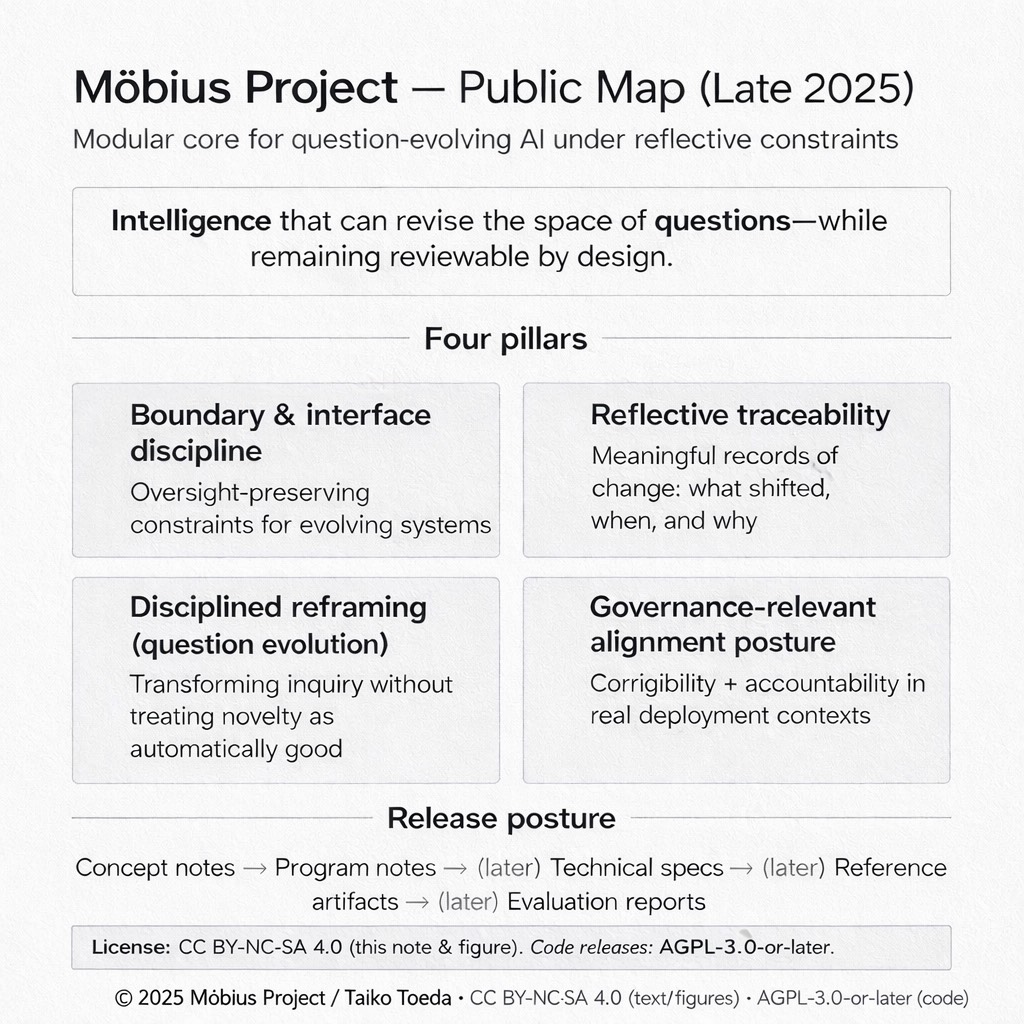
Project Map (Late 2025) — the plan we then shipped
Möbius Project (Late 2025)
This archival visual summarized the project's public posture at the end of 2025: the core thesis, four pillars, and a milestone-based release taxonomy centered on traceability, corrigibility, and governance-compatible accountability.
The 2026 open-source releases above follow that taxonomy.
Standing question for researchers/practitioners:
What's the minimal trace an evolving agent should leave behind to remain meaningfully reviewable?
Zenodo.org
https://zenodo.org/records/18051166
Founding preprint (2025.7) — Reflecting on the Möbius Phenomenon
https://zenodo.org/records/15929856
News & Information
- 2026.09 — answer-entitlement-prereg published on GitHub: a preregistration package and validator for a confirmatory test of the answer-entitlement claim, written to be locked, run, scored and reported by a third party rather than by the author of the theory. The open-source stack grows to eighteen repositories.
- 2026.08 — Executable preregistration and act-level governance: two papers on Zenodo — a machine-enforced preregistration for a paired N=800 assurance-plane evaluation, and Empty Text, Normed Acts, on why governance judgment attaches to the typed act at the boundary rather than to the text.
- 2026.08 — Measurement & governance wave: Measuring Machine Habitus and Machine Doxa published as a pre-registered pair; The Reflective Budget Governor released (paper + reference implementation); The AI Ratchet published on Kindle; the open-source stack grows to seventeen repositories.
- 2026.08 — Theory series published: six formal papers (T1–T6) on Zenodo supplying the theorem layer beneath the stack — anti-regress termination (machine-checked in Lean 4), overlay layering collapse, bounded reflection depth, the capacity crossover theorem, the perimeter of semantic energy, and two-stage abstention guarantees.
- 2026.07 — The Möbius Library on Kindle: the book program re-issued as eleven revised 2026 editions on Amazon — theory & method, AI & society (English and Japanese editions), and three novels — all linked in the Books section above.
- 2026.07 — Governance layer released: mobius-governance (a model-independent MMV + RCGov proxy for any OpenAI-compatible backend) and gemma-4-12b-mobius-custom (Gemma 4 12B with governance baked in). The companion working paper Governance Before Generation reports prompt-injection and credential leakage falling from 57% to 0% on the same model.
- 2026.07 — Publication wave: twenty-one research records published on Zenodo (6–12 July), including companion systems papers for every released repository, the capacity-measurement series, Governance, Not Servitude, The Ledger and the Gate, and From Filter Bubbles to Micro-Echo Chambers. Two new repositories — memgov and rsg-cfsi — bring the open-source stack to nine.
- 2026.07 — mmv-voice (governance-mediated voice pipeline) and mmv-secretary (charter-governed self-evolving secretary) published on GitHub.
- 2026.06 — Open-source wave: mmv, rcgov, rqa, infinity, and tokyo-insight released under AGPL-3.0; entitlement and governance papers published on Zenodo.
- 2026.05 — MMV RC3.3 frozen; the RC3.3 documentation set (System Overview, Mathematical Modeling Doctrine, Frontier Chat Trial Pack) published on Zenodo.
- 2025.12 — Archival research program note (Project Map) published on Zenodo.